
Written by Pim Meijboom, cofounder of PM Tours. Chiang Rai is famous for the White Temple, but it is far more than a photo stop, it is the artist capital of Northern Thailand. Many visitors underestimate the journey, though. It is a long drive of about 3 to 3.5 hours each way from Chiang Mai, which means six to seven hours in the van round trip. Is it worth it? Absolutely, if you plan it right. Here is my guide to seeing the best of Chiang Rai without feeling rushed.
Quick answer: Chiang Rai sits about 180 km north of Chiang Mai, roughly a 3 to 3.5 hour drive each way, so it works best as a full day trip with an early start (around 7:00 AM). The three signature sights are the White Temple (Wat Rong Khun), the Blue Temple (Wat Rong Suea Ten), and the Black House (Baan Dam Museum), often paired with the Golden Triangle, where Thailand, Myanmar, and Laos meet on the Mekong. The White Temple charges foreigners 200 THB (from 2026) and has a strict dress code, the Blue Temple is free, and the Black House costs 80 THB. Go on a weekday and arrive early to beat the tour buses.
Chiang Rai day trip: fast facts
Distance from Chiang Mai: about 180 km, roughly 3 to 3.5 hours one way
Is it worth it? Yes, if you leave early (around 7:00 AM) and plan the route well
The signature trio: White Temple (art temple), Blue Temple (contemporary temple), Black House (art museum)
White Temple fee: 200 THB for foreigners from 1 January 2026 (free for Thai nationals, visitors over 70, and children under 120 cm)
Dress code: strict at the White Temple and Blue Temple, shoulders and knees must be covered. The Black House is a museum, so no dress code
Best time to visit: weekdays, arriving early, to avoid the bus crowds at the White Temple
Is a Chiang Rai day trip worth it?
Yes, for most travellers it is worth the long drive, as long as you go in with the right plan. Chiang Rai gives you a completely different flavour from Chiang Mai: contemporary art temples, mountain scenery, hill tribe culture, tea plantations, and the storied Golden Triangle. The honest catch is the travel time. You are looking at six to seven hours in the vehicle round trip, so the key is an early start (around 7:00 AM) and a tight route that avoids backtracking. If you only have a single free day and want to see the famous temples, it is a rewarding trip. If you are very short on time, weigh it against staying closer to Chiang Mai.
A short history of Chiang Rai
Chiang Rai was founded in 1262 by King Mangrai (also written Meng Rai) as the first capital of the Lanna Kingdom, before he later founded Chiang Mai. The city thrived as a trading hub, then faded for centuries before re emerging as a cultural destination. It also carries a heavier history: this was part of the notorious Golden Triangle, one of the world's main opium producing areas from the 1960s to the 1980s, at the meeting point of Thailand, Myanmar, and Laos. Through decades of work by the Thai government and the royal family, opium cultivation was replaced with sustainable agriculture, and today the region is known for tea, coffee, and cultural tourism rather than the opium trade.
The three temples of Chiang Rai at a glance
| Site | Type | Created by | Foreigner fee | Hours |
|---|---|---|---|---|
| White Temple (Wat Rong Khun) |
Contemporary art temple |
Chalermchai Kositpipat |
200 THB (from 2026) |
8:00 AM to 5:00 PM |
| Blue Temple (Wat Rong Suea Ten) |
Contemporary temple |
Putha Kabkaew |
Free | 7:00 AM to 8:00 PM |
| Black House (Baan Dam Museum) |
Art museum | Thawan Duchanee |
80 THB | 9:00 AM to 5:00 PM (closed 12 to 1) |


White Temple (Wat Rong Khun)
The White Temple is Chiang Rai's most famous sight and the reason most people make the trip. It is the work of Thai artist Chalermchai Kositpipat, who began building it in 1997 and funds it privately, so it is as much a contemporary art project as a place of worship. The dazzling white exterior, studded with mirrored glass, symbolises the purity and wisdom of the Buddha, and the bridge to the main hall crosses a sea of reaching hands that represent worldly desire.
What to know: foreigners pay 200 THB from 1 January 2026 (up from 100), which now includes the Cave of Art. Thai nationals enter free, as do visitors over 70 and children under 120 cm. It is open daily from 8:00 AM to 5:00 PM, and it sits about 13 km south of Chiang Rai city. Photography is not allowed inside the main hall (the ubosot), and the dress code is strict: cover your shoulders and knees. Arrive at opening time on a weekday, as tour buses from Chiang Mai tend to arrive from mid morning. You can read our full guide here: White Temple, everything you need to know.

Blue Temple (Wat Rong Suea Ten)
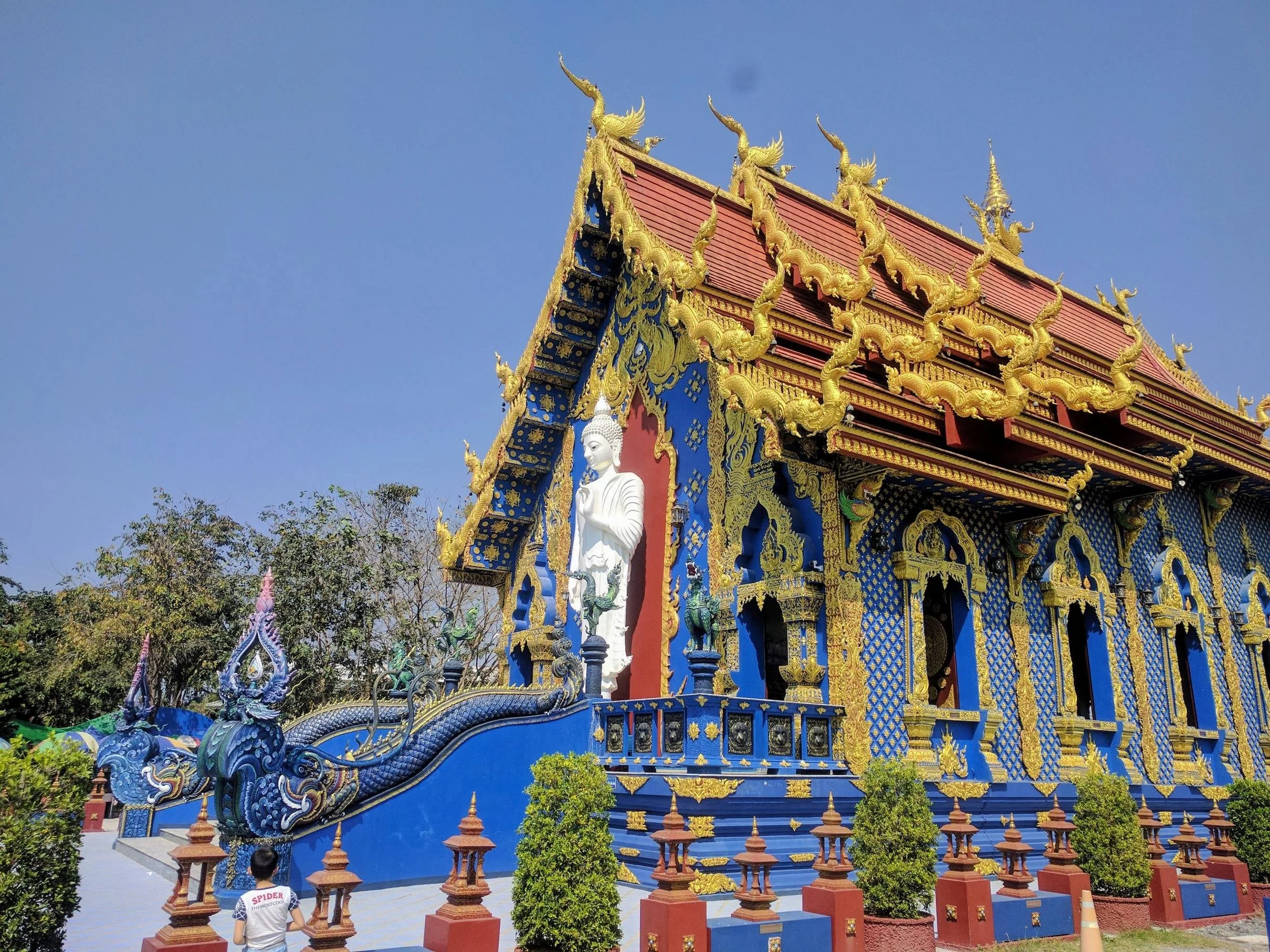
The Blue Temple is the quieter, sapphire coloured counterpart to the White Temple, and one of the most photogenic spots in Chiang Rai. Its Thai name, Wat Rong Suea Ten, means "temple of the dancing tiger," after the tigers said to have roamed the abandoned site long ago. Construction of the current temple began in 2005 and was completed in 2016, designed by the artist Putha Kabkaew, a student of the White Temple's creator. Inside, a large white Buddha sits against deep blue walls covered in gold detailed murals.
What to know: entry is free, and it is open daily from around 7:00 AM to 8:00 PM, a short drive north of the city centre. As with any temple, dress modestly with shoulders and knees covered. It draws fewer crowds than the White Temple, so it is often the calmer stop of the two.
Black House (Baan Dam Museum)
Despite its nickname the "Black Temple," the Black House is not a temple at all. It is the life's work of the late Thai national artist Thawan Duchanee (1939 to 2014), an estate of more than 40 dark timber buildings set in landscaped gardens, filled with animal bones, hides, horns, and oversized furniture. Locals sum up the pairing neatly: the White Temple is "heaven" and the Black House is "hell." It explores themes of death, desire, and the impermanence of life, and it is one of the most unusual places you will visit in Thailand.
What to know: entry is 80 THB per adult (children under 12 free), and it is open daily from 9:00 AM to 5:00 PM, with a lunch closure from 12:00 to 1:00 PM. It is about 10 to 12 km north of Chiang Rai in the Nang Lae area. Because it is a museum rather than a temple, there is no dress code, but wear comfortable shoes, as the grounds are large and mostly outdoors. Allow around an hour.
The Golden Triangle
The Golden Triangle is the point where Thailand, Myanmar, and Laos meet on the Mekong River, at Sop Ruak, about an hour north of Chiang Rai city. Once the heart of the opium trade, it is now a scenic viewpoint with river boat trips, the Hall of Opium museum, and views across to Laos and Myanmar. A short Mekong boat ride is a highlight of many Chiang Rai tours.
Doi Tung
Doi Tung is a scenic mountain area known for its gardens, cool climate, and the Doi Tung Development Project, started in 1988 by the Princess Mother as a way to replace opium farming with sustainable agriculture and forestry. Today you can visit the Royal Villa and the Mae Fah Luang Garden, learn about the project, and enjoy the mountain views. It is a rewarding stop for anyone interested in the region's transformation.


Doi Mae Salong
Doi Mae Salong is a mountain village with a fascinating history. Chinese soldiers from the Kuomintang army settled here in the early 1960s after fleeing the Chinese Communist Party, and the Thai government allowed them to stay in exchange for helping guard the border. Over half a century later, the village feels like a piece of Yunnan province transplanted into Thailand, with excellent Yunnan Chinese food, tea plantations, and beautiful views. It is a worthwhile detour for those with time.


When to visit Chiang Rai
The best time to visit is the cool, dry season from November to February, when the weather is pleasant and the skies are clear. If you do not mind some rain, the quieter months of June to September bring fewer crowds and lower prices. Whenever you go, weekdays are calmer than weekends at the White Temple.
How to get to Chiang Rai from Chiang Mai
Chiang Rai is about 180 km north of Chiang Mai, and the two cities are well connected. Your main options:
Guided tour: the easiest way, with transport, a guide, and a set route so you are not driving or navigating after a long day. Best if you want to see several sights without stress.
Bus: buses run regularly from Chiang Mai Bus Terminal 3 to Chiang Rai Bus Terminal 1. The journey takes about 3 to 4 hours and costs roughly 150 to 300 THB depending on the class of bus. Book ahead in peak season.
Private car or driver: flexible and comfortable, especially for a group, and lets you set your own pace.
Rented car: the route north on Highway 1 is straightforward and well signposted if you are confident driving in Thailand.
Getting around Chiang Rai
The city centre is compact and easy to explore on foot or by bicycle. For the temples and sights outside the centre, which are spread out, it is best to hire a driver or join a guided tour. Tuk-tuks and songthaews (shared taxis) work well for shorter hops within the city. Or use taxi apps like Grab or Bolt.
What to eat in Chiang Rai
Northern Thai food is some of the best in the country. Do not leave without trying khao soi, the rich, curried noodle soup of the north. Another local favourite is Miang Kham, a moreish snack of wild betel leaves wrapped around ginger, lime, peanuts, coconut, and chilli. Up in Doi Mae Salong, seek out the Yunnan Chinese dishes and locally grown Oolong tea.
Chiang Rai tours with PM Tours
We run two day trips to Chiang Rai from Chiang Mai, each with a different focus.
Chiang Rai and the Golden Triangle
Day trip to Chiang Rai's Golden Triangle
This tour heads north through the mountains to the ancient city of Chiang Rai and on to the Golden Triangle, where Thailand, Laos, and Myanmar meet on the Mekong. Highlights include the White Temple, hill tribe villages for a look at traditional rural life, and a boat trip on the Mekong River.
Three temples and Singha Park
Day trip to Chiang Rai's Three Temples and Singha Park
The best choice if temples are your priority. After a scenic drive and a stop at the Mae Kachan hot springs, you visit the White Temple (Wat Rong Khun), then break for a local buffet lunch before the Red Temple (Wat Huay Pla Kang) and the Blue Temple (Wat Rong Suea Ten). The day finishes at the tea plantations of Singha Park.
Frequently asked questions
-
About 180 km, or roughly 3 to 3.5 hours each way by road. It is best done as a full day trip with an early start.
-
Foreigners pay 200 THB from 1 January 2026 (up from 100), which includes the Cave of Art. Thai nationals, visitors over 70, and children under 120 cm enter free.
-
Yes. The Blue Temple (Wat Rong Suea Ten) has no entrance fee and is open daily from around 7:00 AM to 8:00 PM.
-
The Black House (Baan Dam) is an art museum created by artist Thawan Duchanee, not a temple. Entry is 80 THB, and it is open 9:00 AM to 5:00 PM with a lunch closure from 12:00 to 1:00 PM.
-
Cover your shoulders and knees. Remove your shoes before entering the main hall, where photography is not allowed. Sarongs are available near the entrance if needed.
-
Yes, if you start early and plan the route. You will spend six to seven hours in the vehicle round trip, but the temples, the Golden Triangle, and the mountain scenery reward the effort. A guided tour removes the driving and timing stress.
-
The White Temple (Wat Rong Khun), the Blue Temple (Wat Rong Suea Ten), and the Black House (Baan Dam), often called the colours of Chiang Rai.
About the author: Pim Meijboom is a cofounder of PM Tours, a tour operator based in Chiang Mai and licensed by the Tourism Authority of Thailand (TAT License 24/00757), running guided day trips to Chiang Rai and across Northern Thailand.