
Written by Pim Meijboom, cofounder of PM Tours. I never get tired of visiting Doi Inthanon. Even after dozens of trips, the air feels fresher, the waterfalls hit just as hard, and the views from the top still take my breath away. Whenever guests ask for a full day tour that mixes nature, culture, temples, and fresh mountain air, this is my first recommendation. Here is why Doi Inthanon defines what a national park should be, and everything you need to know to visit.
Quick answer: Doi Inthanon is Thailand's highest mountain at 2,565 metres, the "Roof of Thailand," about 1.5 to 2 hours southwest of Chiang Mai. The park is open daily from around 5:30 AM to 6:30 PM, and foreigners pay 300 THB to enter (150 THB for children, and the ticket is valid for 5 days). The highlights are the summit, the Royal Twin Pagodas, the big waterfalls (Wachirathan and Mae Ya), and the Kew Mae Pan nature trail, which needs a local guide and is closed from June to October. Come on a weekday between November and February for the clearest views and the famous sea of clouds.
Doi Inthanon fast facts
What it is: Thailand's highest mountain and national park, known as the Roof of Thailand
Summit height: 2,565 metres
Park area: about 482 km²
Distance from Chiang Mai: roughly 70 to 90 km southwest, a 1.5 to 2 hour drive
Opening hours: daily, around 5:30 AM to 6:30 PM
Entrance fee (foreigners): 300 THB adults, 150 THB children (3 to 14). Thai nationals pay 60 THB. The ticket is valid for 5 days
Vehicle fee: car 30 THB, motorbike 20 THB
Best time: November to February for cool, clear weather and the sea of clouds
Key tip: the Kew Mae Pan trail is closed June to October and always requires a local guide
Why visit Doi Inthanon?
Doi Inthanon is the single best national park day trip from Chiang Mai, and it packs an unusual amount into one mountain. In a single day you can stand at the highest point in Thailand, walk through mossy cloud forest, see powerful waterfalls, visit two royal pagodas with panoramic views, meet Karen and Hmong hill tribe communities, and learn about the Royal Project that replaced opium farming with coffee and fruit. Because of the elevation, it is also much cooler than the city, a genuine escape from the lowland heat. Many visitors skip it, which is a mistake.
Doi Inthanon entrance fee and opening hours
The park is open every day from around 5:30 AM to 6:30 PM. Foreign visitors pay 300 THB for adults and 150 THB for children aged 3 to 14, while Thai nationals pay 60 THB. Vehicles are charged separately: 30 THB for a car and 20 THB for a motorbike. You buy tickets at the checkpoint on arrival, no advance booking is needed, and the ticket is valid for 5 days, so keep it if you plan to stay overnight or return.
A few extra fees to know about: the Twin Pagodas have a small separate entrance fee of 70 THB that is not part of the park ticket, and the guided trails (Kew Mae Pan and Pha Dok Siew) charge around 200 THB per group for the compulsory local guide. On our tours, the park entry, guide fees and the Twin Pagodas fee are already included.
The summit: the highest point in Thailand
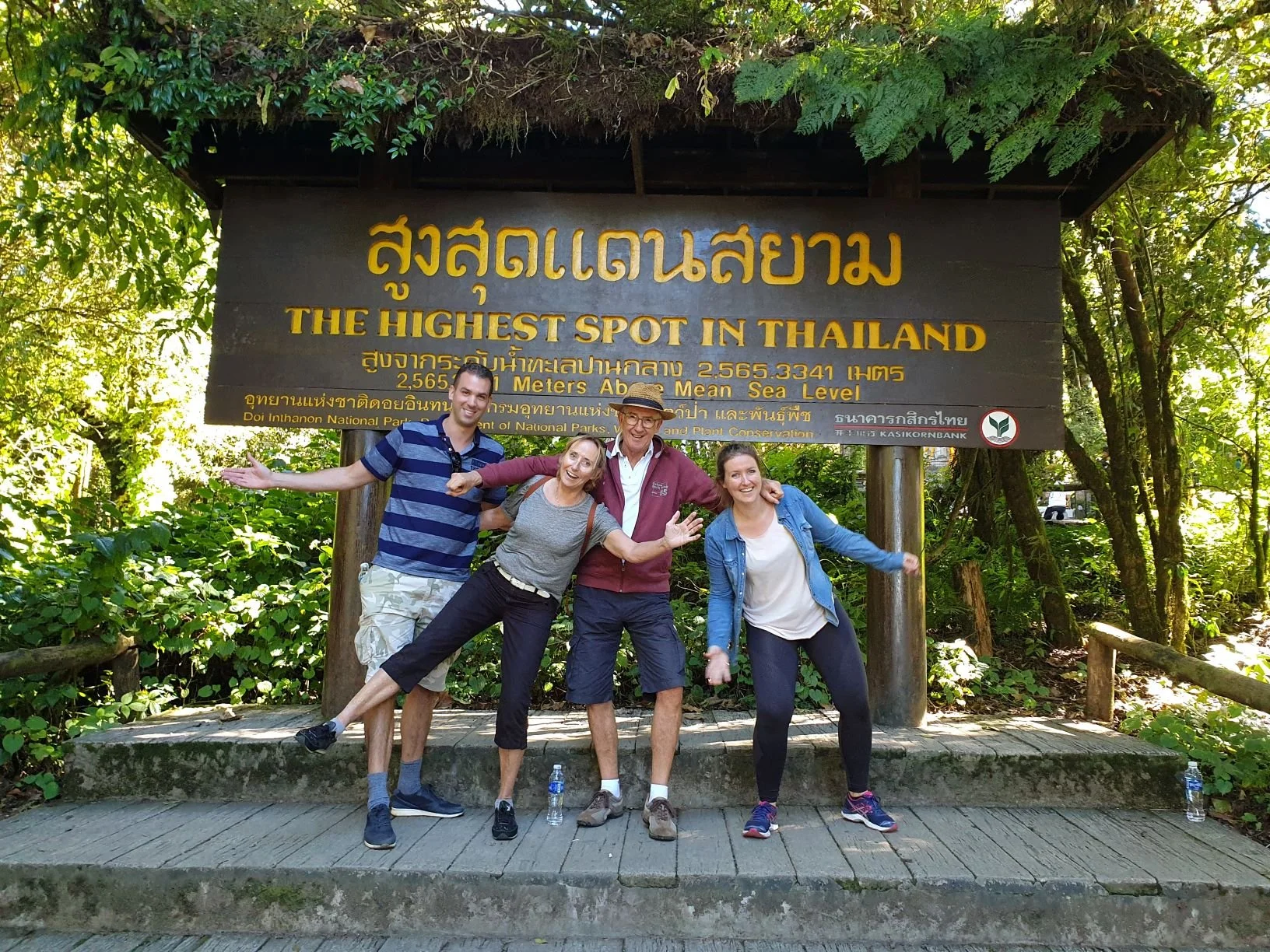
The summit of Doi Inthanon, at 2,565 metres, is the highest point in Thailand, and you can reach it by car, motorbike, or on foot. At the top the air is crisp and cool, and a signpost marks the spot for the classic photo. Beside it stands the stupa of King Inthawichayanon (King Inthanon), one of the last kings of Chiang Mai, who wished to be laid to rest here to protect the mountain and its forests. The park was renamed in his honour. Right by the summit is the short Ang Ka nature trail, a boardwalk loop through a rare, mossy cloud forest.
The Twin Pagodas
The Royal Twin Pagodas, Phra Mahathat Naphamethanidon and Phra Mahathat Naphaphonphumisiri, are among the most photographed sights in the park. They were built to mark the 60th birthdays of the late King Bhumibol Adulyadej and Queen Sirikit, and they stand amid beautifully landscaped gardens with sweeping mountain views. Inside are Buddha images and quiet meditation spaces. A separate small entrance fee of 70 THB applies (included on our tours).


Hiking trails in Doi Inthanon
There are three main trails, and they suit very different energy levels. Here is how they compare:
| Trail | Length | Time | Local guide required | When open |
|---|---|---|---|---|
| Ang Ka (Ang Ka Luang) |
Short boardwalk, under 1 km |
20 to 30 minutes |
No | Year round |
| Kew Mae Pan |
About 3 km loop |
2 to 3 hours |
Yes (around 200 THB per group) |
November to May (closed June to October) |
| Pha Dok Siew |
About 2.6 km | 2 to 3 hours |
Yes (around 200 THB per group) |
Good in the rainy season, the usual alternative when Kew Mae Pan is closed |
Ang Ka is the easy one: a flat boardwalk through mossy forest near the summit, suitable for everyone. Kew Mae Pan, nicknamed the "Heaven Trail," is the star, a ridge walk at around 2,200 metres with grasslands, rhododendrons, and huge views down over the pagodas and valleys. It is your best shot at the sea of clouds at sunrise. It always requires a local Hmong guide, and it is closed each year from June to October so the forest can recover, reopening on 1 November. Pha Dok Siew winds past a waterfall, coffee plantations, and the village of Mae Klang Luang, and it also needs a local guide. You can read more in our Doi Inthanon trekking guide.

Waterfalls in Doi Inthanon
The park is home to some of the finest waterfalls in the north, most of them a short walk from the road:
Mae Ya: one of the tallest and most spectacular, a wide cascade of around 250 metres near the southern entrance.
Wachirathan: a powerful, thunderous fall that throws up a rainbow in the mist, and one of the easiest to reach.
Siriphum: a tiered cascade near the park headquarters and the Royal Project.
Mae Klang: close to the main entrance, a popular first stop.
The waterfalls flow year round but are at their most dramatic during and just after the rainy season. Most sit in rocky areas and are for admiring rather than swimming. For more, see our guide to the top 10 waterfalls in Chiang Mai.

Wildlife
Doi Inthanon is one of the richest wildlife areas in the region, with around 65 mammal species and superb birdlife. In the forest you may spot vibrant birds such as the rare green tailed sunbird and the resplendent sibia, hear gibbons calling, or see macaques, Chinese gorals, wild boar, and deer. Wild elephants and tigers vanished from the park decades ago. If you would like to combine your visit with an ethical elephant experience, you can do so through the Living Green Elephant Sanctuary, formerly Maeklang Elephant Conservation. Wildlife is never guaranteed, but going early with a guide who knows the park greatly improves your chances.
Hill tribe culture and the Hmong market
Doi Inthanon is also one of the best places near Chiang Mai to experience hill tribe culture. Karen and Hmong communities live within and around the park, and visiting their villages offers a genuine look at their crafts, traditional dress, and farming. The Hmong market near the pagodas is full of colourful stalls selling handicrafts, textiles, fruit, and local treats, much of it grown through the Royal Project, and it is a good spot to pick up souvenirs.

The Royal Project
The cool climate and good soil around Doi Inthanon are ideal for coffee, fruit, vegetables, flowers, and herbs. Local farmers once grew opium here, but when King Bhumibol Adulyadej visited in 1969 and saw their hardship, he launched the Royal Project to replace opium with more profitable, sustainable crops. Roads and irrigation were improved, and the initiative has lifted many northern communities out of poverty. You can visit the Royal Agricultural Station to learn about the work and wander its manicured gardens.

When to visit Doi Inthanon
The best months are November to February: cool, dry, clear, and the prime window for the sea of clouds and the Siamese sakura blossom in late January. All trails are usually open in this period. The rainy season (roughly June to October) brings the greenest forest and the most powerful waterfalls, but also mist, mud, and the Kew Mae Pan closure. Try to avoid the smoky burning season (around March to April) and the New Year holiday, when the park fills with local visitors escaping to the cold.
What to bring
A warm layer or jacket, as the summit is genuinely cold and can approach 0°C on winter mornings (daytime averages are often just 10 to 15°C)
Comfortable walking shoes for the trails
Sun protection and insect repellent
A water bottle
A camera or phone for the pagodas and the views

How to get to Doi Inthanon from Chiang Mai
The park is about 70 to 90 km southwest of Chiang Mai, a 1.5 to 2 hour drive to the entrance, with the summit and pagodas further along the mountain road, so plan a full day. Your options are a guided tour (the easiest, with transport, entry fees, lunch, and a guide handled for you), a private car or driver, a rented car or motorbike via Highway 108 to Chom Thong then Highway 1009, or a red songthaew for a more local, budget experience. The mountain road is well maintained but steep and winding near the top, so ride with care if you are on a motorbike.
Doi Inthanon tours with PM Tours
We run two full day tours, both including the park entrance fee, the Twin Pagodas fee, transport, lunch, and an English speaking guide.
Doi Inthanon full day sightseeing tour
The relaxed option, covering the highlights: the summit, the Twin Pagodas, the Ang Ka nature trail, the big waterfalls, a Karen hill tribe village, and the Hmong market, with insightful commentary throughout. Ideal if you want to see a lot without a demanding hike.
Doi Inthanon trekking tour (Kew Mae Pan)
The active option for nature lovers, with more time on the trails. You hike two routes, the Kew Mae Pan trail from November to March or the Pha Dok Siew trail from April to October depending on the season, plus the short Ang Ka nature trail, and you still visit the Twin Pagodas, Wachirathan waterfall, a Karen village, and the Hmong market. This trip also includes insurance.
Frequently asked questions
-
Foreigners pay 300 THB for adults and 150 THB for children aged 3 to 14. Thai nationals pay 60 THB. Cars are charged 30 THB and motorbikes 20 THB. The ticket is valid for 5 days.
-
The park is open daily from around 5:30 AM to 6:30 PM. You buy tickets at the checkpoint on arrival.
-
About 70 to 90 km southwest, a 1.5 to 2 hour drive to the park. The summit and pagodas are further up the mountain, so it is a full day trip.
-
The summit is 2,565 metres, the highest point in Thailand.
-
No. Kew Mae Pan is closed every year from June to October for forest recovery and reopens on 1 November. It also always requires a local Hmong guide, around 200 THB per group.
-
The Kew Mae Pan and Pha Dok Siew trails require a compulsory local guide. The short Ang Ka boardwalk near the summit does not.
-
November to February for cool, clear weather and the sea of clouds. Avoid the smoky burning season around March to April and the busy New Year holiday.
-
Wachirathan for sheer power and Mae Ya for height (around 250 metres) are the standouts, with Siriphum and Mae Klang also worth a stop.
About the author: Pim Meijboom is a cofounder of PM Tours, a tour operator based in Chiang Mai and licensed by the Tourism Authority of Thailand (TAT License 24/00757), running guided day trips to Doi Inthanon and across Northern Thailand.